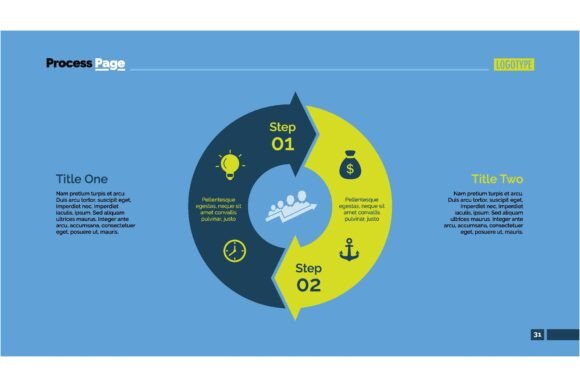
Circle Arrow Diagram Slide Template: A Strategic Framework for Clearer Communication
Every meaningful business decision starts with a need to connect ideas, show movement, or explain a cycle. The Circle Arrow Diagram Slide Template is a visual tool designed to do exactly that—without forcing you to become a designer. It’s a pre-built, adaptable graphic element that arranges arrows in a circular flow, helping you map processes, strategies, feedback loops, and phased plans in a way that feels immediate and intuitive. Whether you’re presenting to investors, facilitating a team workshop, or building an internal report, this template can shift a confusing set of bullet points into a narrative that sticks.
What sets this particular resource apart is its flexibility. It doesn’t lock you into a single metaphor. The circular arrow structure can represent a four-step marketing funnel, a continuous improvement cycle, a stakeholder mapping exercise, or even a timeline with a return loop. Because it comes as a slide template, you spend less time aligning shapes and more time refining the logic behind your message. That shift—from formatting to thinking—is where the real strategic value lies.
Why Circular Logic Works in Business Communication
Linear thinking dominates most slide decks: step one, step two, step three. But many business realities are cyclical. Customer journeys loop back. Product development spirals through iteration. Strategic planning revisits vision after market feedback. A Circle Arrow Diagram Slide Template mirrors this non-linear truth. When you show a process returning to its starting point, you acknowledge that improvement is ongoing, not a one-time event. This visual cue alone can change how your audience processes information, inviting them to think about systems instead of isolated tasks.
From a cognitive standpoint, circular diagrams reduce the mental load of tracking relationships. Arrows that form a closed shape signal interdependence. For a project manager outlining a quarterly rollout, placing interdependent phases in a circle helps stakeholders quickly grasp that delays in one area will ripple. For a marketer explaining a brand awareness model, the loop communicates that discovery, consideration, conversion, and advocacy feed into each other, not just forward. The template gives you that framing instantly, so you can focus on the content specificity your situation demands.
Choosing the Right Moment to Deploy the Template
Not every slide needs a diagram. The key is to use the Circle Arrow Diagram Slide Template when the relationship between parts matters more than the parts themselves. Consider these practical triggers:
- You’re explaining a recurring process — Monthly reporting, sprint retrospectives, or content calendars benefit from a loop that highlights cadence and feedback.
- You’re mapping a journey with a feedback mechanism — Customer lifecycle, employee onboarding, or product returns often require a visual that shows where the experience loops back for refinement.
- You’re connecting strategy to execution — A classic OGSM (Objectives, Goals, Strategies, Measures) framework can feel abstract in a table. A circular arrow version shows how measurement informs new objectives.
- You’re teaching a framework — For educators or team leads, the template transforms theory into a memorable, shareable image that learners can recall later.
Using it outside these contexts risks decoration over function. If you’re simply listing options with no relationship, a simple column layout might be clearer. The template’s strength is interdependence; force it onto unrelated items and you may confuse rather than clarify.
Laying the Groundwork Before You Customize
It’s tempting to open the template and start typing. A better approach is to spend fifteen minutes answering three questions:
- What’s the one insight I want the audience to leave with? If your diagram shows a product lifecycle, is the insight about speed, sustainability, or customer involvement? The answer determines which phase gets visual emphasis.
- What are the precise nodes in this cycle? Avoid vague labels like “Step 1.” Use outcome-oriented language: “Validate Assumptions” or “Secure Budget.” Each arrow should advance a story beat.
- Where does the loop really start and end? For a strategic planning cycle, does it begin with data gathering or leadership alignment? Your choice sets the tone for the entire visual. The template allows you to rotate entry points—use that deliberately.
Once you’ve clarified these, customizing the Circle Arrow Diagram Slide Template becomes an exercise in precision, not guesswork. You can adjust colors to match brand palettes, resize icons to reinforce meaning, and add brief annotations without cluttering the core flow. The goal isn’t to fill every arrow with text; it’s to make each node so clear that a viewer understands the cycle without reading a separate explanation.
Strategic Planning Workshops
During annual planning, teams often brainstorm goals, initiatives, and metrics but struggle to show how they interlock. Place the central strategic pillar in the middle, surround it with four key initiatives in the arrow nodes, and you have a one-page visual that ties resources to outcomes. The circular shape inherently communicates that no initiative operates in isolation. Plus, when you revisit the plan mid-year, you can use the same template to show progress and adjust the loop—reusing the asset saves time and maintains conceptual continuity.
Marketing Campaign Architecture
A multi-channel campaign isn’t a straight line from ad to sale. A Circle Arrow Diagram Slide Template can map awareness, engagement, conversion, and retention around a customer persona. Adding small annotations about channel ownership at each arrow helps cross-functional teams see where they hand off. This reduces siloed thinking and surfaces gaps—if the arrow from conversion to retention feels weak, you know a loyalty program or remarketing sequence needs attention.
Product Development Iterations
Agile teams can use the diagram to illustrate the build-measure-learn loop without jargon. Each arrow represents a phase: prototype, user test, analyze feedback, refine. Include timelines in each segment and the template becomes a roadmap that stakeholders outside the development team can grasp instantly. The circularity reinforces that shipping a feature isn’t the end; it’s fuel for the next iteration.
Employee Experience and Onboarding
HR professionals can map the employee journey from recruitment to alumni advocacy as a continuous loop. Highlighting touchpoints like pre-boarding, first 90 days, ongoing development, and exit interviews shows leadership that employee experience is a system, not a set of isolated programs. The visual often sparks conversations about handoffs between departments—something a linear list never quite captures.
Common Pitfalls That Undermine Clear Thinking
Even the best-designed template can become a liability if it’s used as a shortcut around real strategic work. A common mistake is to force-fit a cycle where none exists. I’ve seen teams twist a simple sequential process into a circle just because the template looked good. The result is a confusing graphic that raises more questions than it answers. If your process genuinely ends—like a one-time event plan—opt for a timeline or a flowchart instead.
Another risk is overcrowding. The Circle Arrow Diagram Slide Template works because of its clarity. When you cram eight nodes into the circle, the font shrinks, the arrows become hard to follow, and the audience disengages. As a rule of thumb, limit yourself to three to six phases. If you have more, consider breaking the cycle into layers or using multiple slides to tell a progressive story.
Lastly, watch out for meaningless arrows. Every arrow in your diagram should represent a genuine transfer, input, or trigger. If you label one “Continue” and it adds no new information, you’re wasting visual real estate. Be rigorous: if you can’t explain the arrow’s role in a single sentence, rethink it.
Integrating the Template Into a Longer-Term Visual Strategy
One-off diagrams are easy to forget. But when you reuse the Circle Arrow Diagram Slide Template across multiple presentations—say, in a quarterly business review deck, a project charter, and a team meeting update—you build a visual signature. Your colleagues and clients start associating that clean, circular logic with your thinking. This consistency strengthens your personal or organizational brand without extra effort.
To make this sustainable, create a style guide note that specifies the template’s primary use cases and adaptation rules. For instance, you might decide that the circle is always rendered in the company’s secondary color palette, that arrows remain solid during active cycles and become dashed during paused phases, or that each node carries an icon from a fixed library. These small decisions turn a generic slide element into a proprietary thinking tool.
Also consider pairing the template with other slide assets in your library. A well-crafted strategic framework slide might introduce the logic, the circle diagram shows the cycle, and a supporting table or chart provides data. When these elements work together, your narrative gains depth. The circle diagram handles the synthesis; the other slides handle the evidence.
Adapting for Different Audiences Without Losing Integrity
An executive wants to see the big picture quickly. A front-line manager needs enough detail to act. The same Circle Arrow Diagram Slide Template can serve both when you adjust the layer of detail. For a leadership presentation, keep labels short and add a single key takeaway per arrow. For a training session, you might expand each node into its own mini-slide, using the circle as a recurring anchor that ties everything back together. The template’s value isn’t just in the graphic itself but in the mental model it creates—once someone internalizes the cycle, you can unpack any part of it without losing context.
When presenting to external partners or clients, be mindful of proprietary information. The template’s clean design makes it easy to generalize names without diluting the flow. Swap “Q3 Product Launch” with “Phase 2 Rollout” or “Client Onboarding” with “Initial Engagement.” The structural logic stays intact, and you protect sensitive details while still demonstrating operational maturity.
Moving From Decoration to Decision Support
A slide template is never the answer on its own. But in a world where attention is fragmented and ideas are complex, the way you structure information can be the difference between an approved initiative and a forgotten proposal. The Circle Arrow Diagram Slide Template offers a low-friction way to elevate your communication from a list of items to a story about movement, connection, and progress. Use it to explore feedback loops before they become problems, to align teams around a shared sequence, or to make abstract strategy feel tangible.
Start with the outcome you need. Choose the template only when a cycle genuinely exists. Simplify ruthlessly. Then let the visual do the heavy lifting while you focus on the conversation that follows. That’s when a well-chosen diagram stops being a slide and starts working as a strategic asset.