The Art of Minimalist Design: What a Pair of Chopsticks Teaches Us About Visual Communication
There is something quietly profound about a pair of chopsticks. Two slender sticks, identical in form, yet capable of extraordinary precision. They lift, separate, gather, and guide with a grace that forks and spoons rarely match. This elegant simplicity has fascinated designers, illustrators, and visual storytellers for generations. When we distill an object down to its essential lines without losing its identity, we arrive at the core of what makes illustration powerful. It is precisely this philosophy that underpins thoughtfully crafted vector collections, where every curve, node, and color choice carries intentional weight.
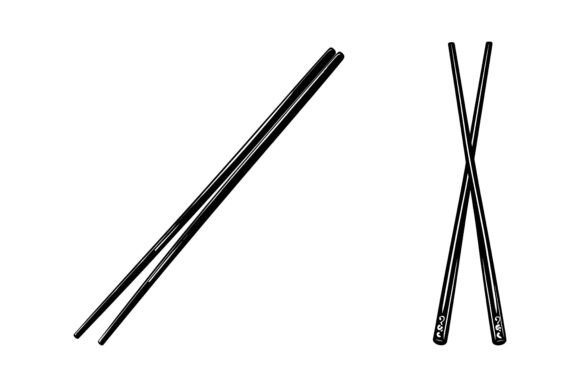
The Hello Welcome to our Special AI EPS Collections embodies this mindset. These are not merely bundles of clip art thrown together for convenience. They represent a studied approach to visual assets, where the humble elegance of everyday objects receives the attention it deserves. Consider a pair of chopsticks rendered as a vector illustration. The illustrator must decide how much detail to retain, how to handle the taper, whether to include wood grain or keep surfaces smooth, and what shadowing technique best communicates depth without clutter. Each decision shapes how the final image communicates across different contexts.
Why Vector Format Matters for Everyday Iconography
Vectors differ fundamentally from raster images. Instead of storing pixel data, they record mathematical paths defined by points, curves, and angles. When you open an AI or EPS file containing a pair of chopsticks, you are looking at scalable geometry. Enlarge it to billboard dimensions and the lines remain razor-sharp. Shrink it to a mobile app icon and no detail collapses into muddiness. This scalability alone transforms how designers approach their work, but the advantages run deeper.
The file structure provided in these collections, neatly organized with clearly named layers, saves hours of production time. Imagine receiving a complex illustration with dozens of unlabeled paths. Now contrast that with opening a file where the chopsticks sit on their own named layer, separable from the bowl, the steam wisps, or the surrounding table setting. You can isolate, recolor, or repurpose individual elements without hunting through hundreds of anonymous objects. This organizational discipline reflects a respect for the end user that separates professional resources from amateur offerings.
Cross-platform compatibility further extends the usefulness. Whether you work on a Mac or Windows machine, the AI EPS format preserves editability. The inclusion of JPG previews provides immediate visibility into file contents without requiring specialized software. For teams where some members use Adobe Illustrator and others rely on alternative tools, this flexibility eliminates friction.
Precision and Consistency Across Every Asset
Consistency in illustration sets is harder to achieve than most people realize. A single designer working across dozens of icons must maintain uniform stroke weights, corner radii, color palettes, and stylistic choices. When the set includes a pair of chopsticks alongside other culinary or cultural items, those chopsticks must feel like they belong to the same visual family as a teapot, a sushi roll, or a bamboo steamer. Inconsistency creates visual noise that undermines professional presentation. The collections described here prioritize this cohesion, delivering assets where every element shares the same design DNA.
Perfection in details manifests in small but impactful ways. The slight reflection on a lacquered chopstick surface, the subtle shadow where two sticks cross, the precise angle of the tapered tip, all of these micro-decisions accumulate into an illustration that reads instantly and authentically. When a viewer glances at an icon and recognizes it without conscious effort, the designer has succeeded. This threshold of recognition depends entirely on those meticulously executed details.
Practical Applications Across Industries and Media
The versatility of well-crafted vector illustrations extends across an impressive range of use cases. A restaurant developing its digital menu might incorporate a pair of chopsticks as a visual cue next to applicable dishes, guiding customer expectations before they read a single word. The same icon, recolored and slightly scaled, could mark chopstick-friendly options on a food delivery app interface. An educational publisher creating materials about global dining customs might use these illustrations to accompany text explaining proper chopstick etiquette across different Asian cultures. The asset adapts without degradation.
Infographics represent another domain where these illustrations excel. Data visualization often benefits from thematic icons that anchor abstract numbers to concrete concepts. A statistic about utensil preference across countries gains immediate legibility when paired with recognizable imagery. Because the files allow easy color modification, designers can align the illustration palette with brand guidelines or data category schemes without compromise.
Print applications benefit equally. Magazine layouts, cookbook designs, restaurant menus, and cultural event posters all demand high-resolution output. Vector files deliver clean results at any DPI requirement for offset or digital printing. The organized layer structure becomes especially valuable during pre-press workflows, where separations and spot color assignments require precise element isolation.
Customization as a Creative Accelerator
The ability to edit colors and modify forms distinguishes truly useful illustration sets from rigid, single-purpose downloads. Perhaps the default chopsticks appear in natural wood tones, but a project demands vibrant red lacquer with gold accents. Opening the AI file, selecting the relevant paths, and applying new fills takes moments. More ambitious modifications might involve shortening the chopsticks for a children's educational game, duplicating and rotating them to create a pattern, or combining them with other elements from the set to build a completely new composition.
This editability extends the lifespan of the asset purchase. A designer who buys an illustration set for a specific project often discovers new applications months or years later. The same pair of chopsticks that once decorated a restaurant website might later appear in a cultural diversity training module, a travel blog header, or a product packaging design for imported snacks. Because the files remain editable, each new context receives a treatment appropriate to its specific visual requirements.
For symbols and app interfaces, the ability to simplify or elaborate on the base illustration proves invaluable. An app icon might demand a highly simplified, almost geometric representation, while a splash screen for the same app could feature a richer, more detailed rendering. Starting from a single well-constructed vector file, a designer can produce both versions without commissioning separate assets.
Understanding the Technical Architecture
Behind every smooth curve and crisp edge lies a considered technical structure. The AI EPS format preserves editable text, gradients, and effects while maintaining compatibility across versions of Adobe Illustrator and other vector editing software. The JPG inclusion serves a dual purpose: it allows quick previewing in file browsers and provides a raster fallback for contexts where vector support might be inconsistent. This thoughtful pairing reflects an understanding of real-world design workflows, where speed and flexibility often determine project success.
Neatly organized file and layer structures might sound like a minor convenience, but anyone who has inherited a chaotic design file understands their true value. Named layers allow designers to toggle visibility, lock elements, and navigate complex compositions without guesswork. When a pair of chopsticks sits on a layer labeled appropriately, perhaps alongside related utensils in a grouped hierarchy, the mental overhead of managing the asset drops significantly. This organization also facilitates collaboration, as team members can quickly orient themselves within an unfamiliar file.
Design Philosophy Rooted in User Empowerment
The underlying philosophy of these collections centers on giving creative control to the end user. Rather than presenting illustrations as finished, immutable products, they arrive as flexible starting points. You can deconstruct them, recolor them, scale them, and recombine them. This approach acknowledges that no two projects share identical requirements. A corporate presentation demands different visual treatment than a children's book, yet both might benefit from the same foundational illustration adapted appropriately.
This philosophy extends to the purchasing model. The invitation to buy now and start using the illustration immediately emphasizes readiness and immediacy. There is no complex licensing negotiation, no waiting for custom deliverables, and no uncertainty about file formats. The assets exist as complete, organized packages ready for download and deployment. For professionals working against deadlines, this instant availability carries genuine value.
Cultural Resonance and Visual Literacy
Illustrations of everyday objects carry cultural weight beyond their immediate visual function. A pair of chopsticks communicates not just a utensil but a set of associations: cuisine, tradition, craftsmanship, mindful eating, and cultural identity. When designers select such imagery, they tap into these resonances whether they intend to or not. The quality of the illustration either honors or trivializes these associations. Detailed, respectful renderings demonstrate cultural awareness; crude approximations risk appearing careless or appropriative.
The collections discussed here, with their emphasis on perfection in details and consistency, suggest a conscientious approach to representation. When an illustrator takes the time to understand the subtle taper of chopsticks, the way they rest together, and the materials from which they are traditionally made, the resulting image carries authenticity. This authenticity communicates to viewers, building trust and engagement in ways that generic stock imagery cannot match.
Visual literacy, the ability to interpret and derive meaning from images, has become increasingly important in digital communication. Icons and illustrations now carry significant informational load across websites, applications, and social media. Investing in high-quality visual assets represents an investment in clear communication. When users encounter familiar objects rendered with precision and care, their cognitive processing speeds up. They recognize, understand, and move forward without friction.
Making Informed Decisions About Visual Resources
Choosing illustration sets requires evaluating several factors beyond aesthetic appeal. File compatibility with existing software and workflows ranks high among practical concerns. The AI EPS format enjoys broad support across professional design tools, making these collections accessible to users regardless of their preferred platform. The inclusion of JPG files adds a layer of convenience for quick placements and previews.
Editability represents another critical factor. Some illustration sets arrive as flattened, uneditable files that resist adaptation. The collections described here take the opposite approach, encouraging users to modify colors, adjust forms, and customize outputs according to project needs. This flexibility multiplies the utility of each asset, as a single illustration can serve diverse purposes across different contexts with appropriate modifications.
Organizational quality, while less immediately visible than aesthetic quality, profoundly impacts workflow efficiency. Well-structured files with logical layer naming and grouping reduce the time required to locate and manipulate specific elements. For complex compositions involving multiple objects, this organizational clarity can mean the difference between a smooth editing session and a frustrating hunt through anonymous paths.
Suitability across media, print, web, symbols, apps, and infographics, ensures that the investment in these assets pays dividends across projects. A designer who purchases an illustration set for a web project may later draw from the same library for print collateral, social media graphics, or presentation decks. The versatility inherent in vector formats supports this cross-media application without quality loss or format conversion headaches.
Ultimately, the decision to acquire illustration resources should rest on a clear-eyed assessment of current and anticipated needs. Designers who frequently work with food, culture, or lifestyle themes will likely find themselves reaching repeatedly for well-crafted illustrations of everyday objects. The Hello Welcome to our Special AI EPS Collections offering positions itself as a practical, adaptable resource built on principles of quality, organization, and user empowerment. For those whose work demands visual assets that combine aesthetic appeal with technical flexibility, the value proposition aligns with real professional requirements.